Design – Build
From Concept to Completion
Design-build is about reducing handoffs and speeding delivery. When the team planning the work is also the team building it, you get clearer scopes, fewer surprises, and better field decisions.
What Design – Build Looks Like with Us
- Early site review + constraints
- Scope definition and budget ranges
- Practical sequencing and constructability input
- Coordination with survey/engineering/permits as required
- Field execution with accountability end-to-end
Best Fit Projects
- Commercial expansions
- Complex residential builds (slope/drainage/access)
- Campgrounds and specialty properties
- Worry and Stress Free projects
- Underground infrastructure with coordination needs
Design – Build Benefits
Save Time
Faster Construction Speed – 36% Faster
Faster Delivery Speed – 102% Faster
Less Schedule Growth – 11.4% Less
Compressed Schedule Time
Reduce Costs

Lower Costs – 6.1% Less
Less Cost Growth – 5.2% Faster
Reduce Mistakes

Same Team
Same Goals
Ongoing plan adjustments
Reduced change orders
Higher quality outcome
Traditional Construction vs. Design-Build Model
“One Entity, One Contract, One Unified Flow of Work” – Design-Build Institute of America
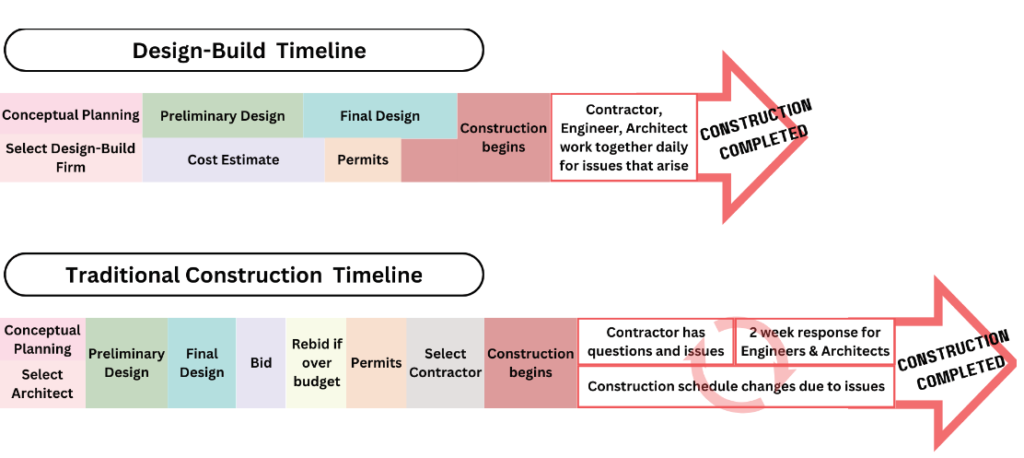
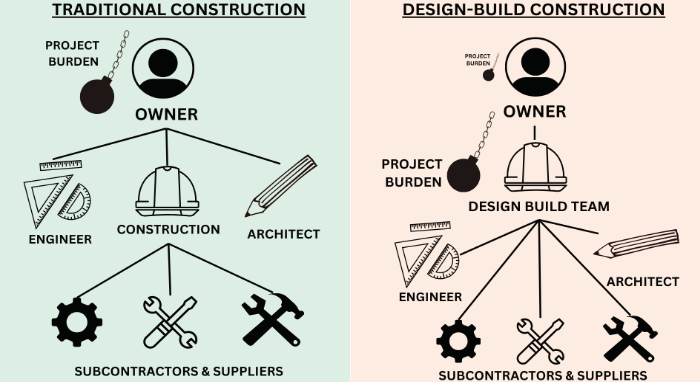
Traditional methods require the owner to first hire design teams (engineer and architect) to create their project design. The project then goes out to bid and contractors estimate the project costs and a budget is established. As construction begins, the owner takes responsibility for coordinating and facilitating communication between the engineers, architects, and contractors. When the contractor has questions or issues arise, it can take an average two weeks for an engineer or architect to respond. This of course lengthens the project schedule, increases mistakes and change orders due to miscommunications, delays subcontractor timelines, etc., all which increases costs for the project.
The Design-Build Model increases efficiency for project development from the start. Once the owner hires the Design-Build firm, architects, engineers, and contractors work together to develop the designs, build cost estimates, and start construction in a shorter timeline. The increased communication and collaboration amongst the designers and builders allows for more innovation, fewer mistakes, fewer schedule changes, minimizes costs and creates overall higher satisfaction and less burden for the project owner.
The many benefits of the Design-Build Model make it a popular method of building with 42% of projects in the U.S. utilizing the model. Use of the model is projected to grow in the next decade.
U.S. utilizing the model. Use of the model is projected to grow in the next decade.